“Barefoot? Here?”
Not across the entire city centre. Perhaps start with ten clean, clearly visible metres.
An invitation for people who wear shoes
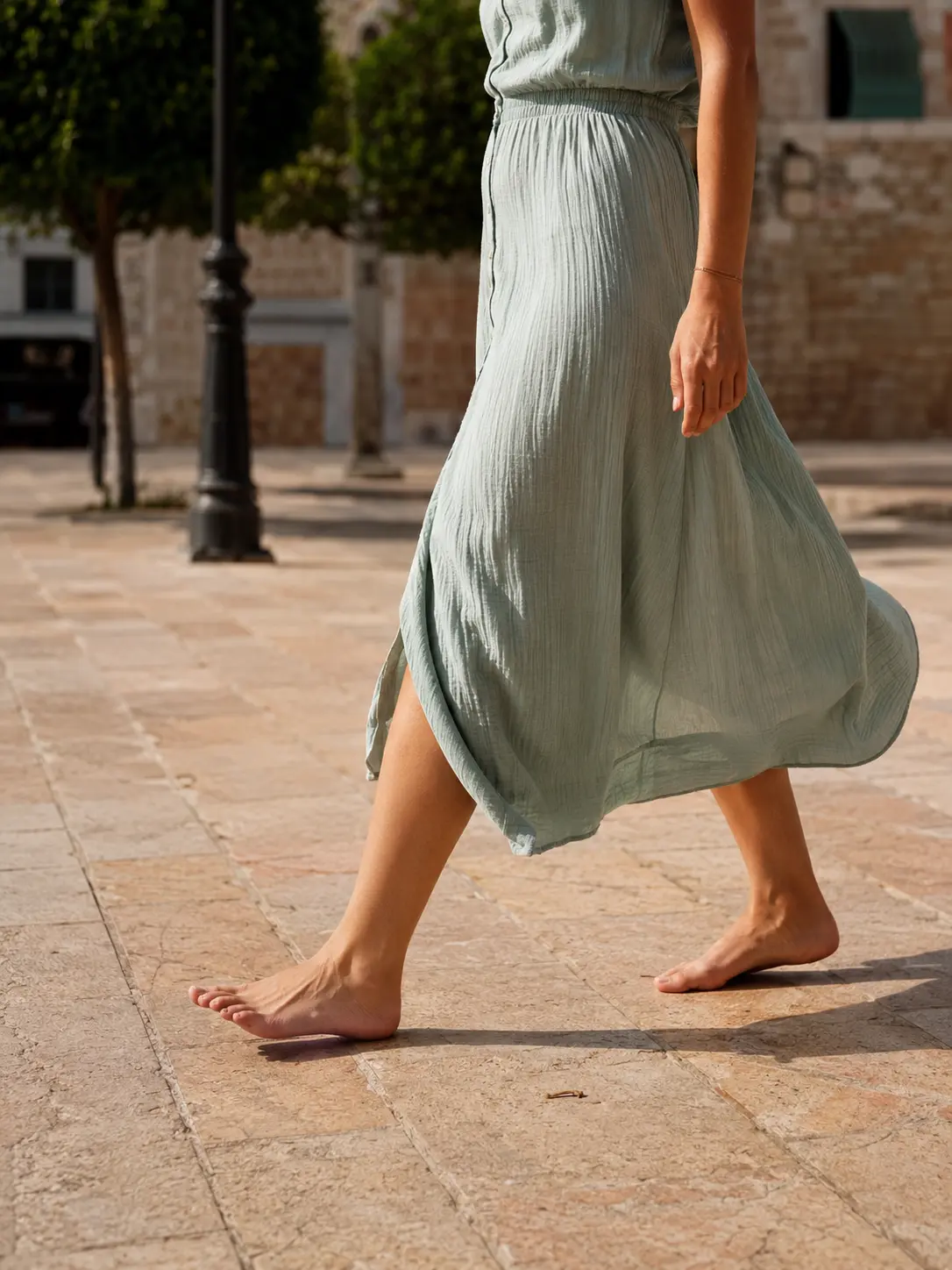
You do not need to become a barefoot person. Simply take a few steps without the usual layer in between - then decide how it feels.
Your first thought may be sceptical
Almost anything looks strange while nobody does it. Soleful is not here to convert you. It only pauses the social autopilot for a moment: do you need shoes for this path - or do you put them on because that is simply what people do?
Not across the entire city centre. Perhaps start with ten clean, clearly visible metres.
Probably less than you expect. After a few steps, the ground is usually more interesting than a passing glance.
No. Shoes remain a useful tool. You simply choose more consciously when you need them.
Curiosity is enough. Conviction is not required.
Ordinary elsewhere
There is no model barefoot nation. But there are places where bare feet need far less explanation - at school, during sport and occasionally even at the supermarket.
Aotearoa New Zealand
In a study of 714 boys at an affluent Auckland school, 45% were classified as habitually barefoot. About one in five went barefoot for at least half of their supermarket visits.
One school, not a national figure - but a clear cultural signal.Read the studyLord Howe Island, Australia
On the small island, children cycle barefoot to class. Shoes are explicitly optional at the local school.
A specific island culture - not a blanket statement about Australia.Read the reportSouth Africa
National guidance lists shoes among the optional parts of a school uniform. Climate, culture and affordable access to education all play a role.
Life without shoes does not have the same reasons everywhere - which is why context matters.Read the contextNormality is not created by rules. It starts when somebody begins.
The smallest possible experiment
Choose a visible section where you feel safe. Keep your shoes in your hand. After ten metres you may put them straight back on - or add another ten.
Where could your first ten metres be?
Walk to the letterbox or the edge of your property. Familiar ground removes much of the drama from a first attempt.
Choose light, clean and clearly visible ground.
No tiptoes and no special technique. Calm, compact and relaxed.
Cool, warm, smooth, grainy? Observe first and judge later.
If the ground is hot, pain is sharp or skin breaks: put your shoes back on. The experiment still counts.
What suddenly appears
Without a rigid sole, distance becomes surface again. It does not need to be spiritual or athletic. It is simply more information.
direct · predictable · urban
soft · cool · yielding
alive · changing · concealed
precise · slow · demanding
The same path may not suddenly feel better. It will almost certainly feel less forgettable.
Freedom also means putting shoes back on
Hot asphalt, glass, thorns, certain workplaces or a tired foot are not defeats. Soleful does not turn shoes into an enemy - it only turns automatic shoe-wearing into a conscious choice.
Check dark surfaces briefly, inspect unfamiliar ground and care for wounds properly.
Private places and workplaces may set their own rules. Quiet confidence beats a debate on principle.
With diabetes, neuropathy, circulatory problems or reduced sensation, seek medical or podiatric advice first.
When ten metres become more
The detailed guides remain where they belong: as deeper reading, not as an entrance exam.
Something is already waiting outside
Barefoot parks, nature trails and quiet sensory paths across Germany - filterable by region, experience and facilities.